

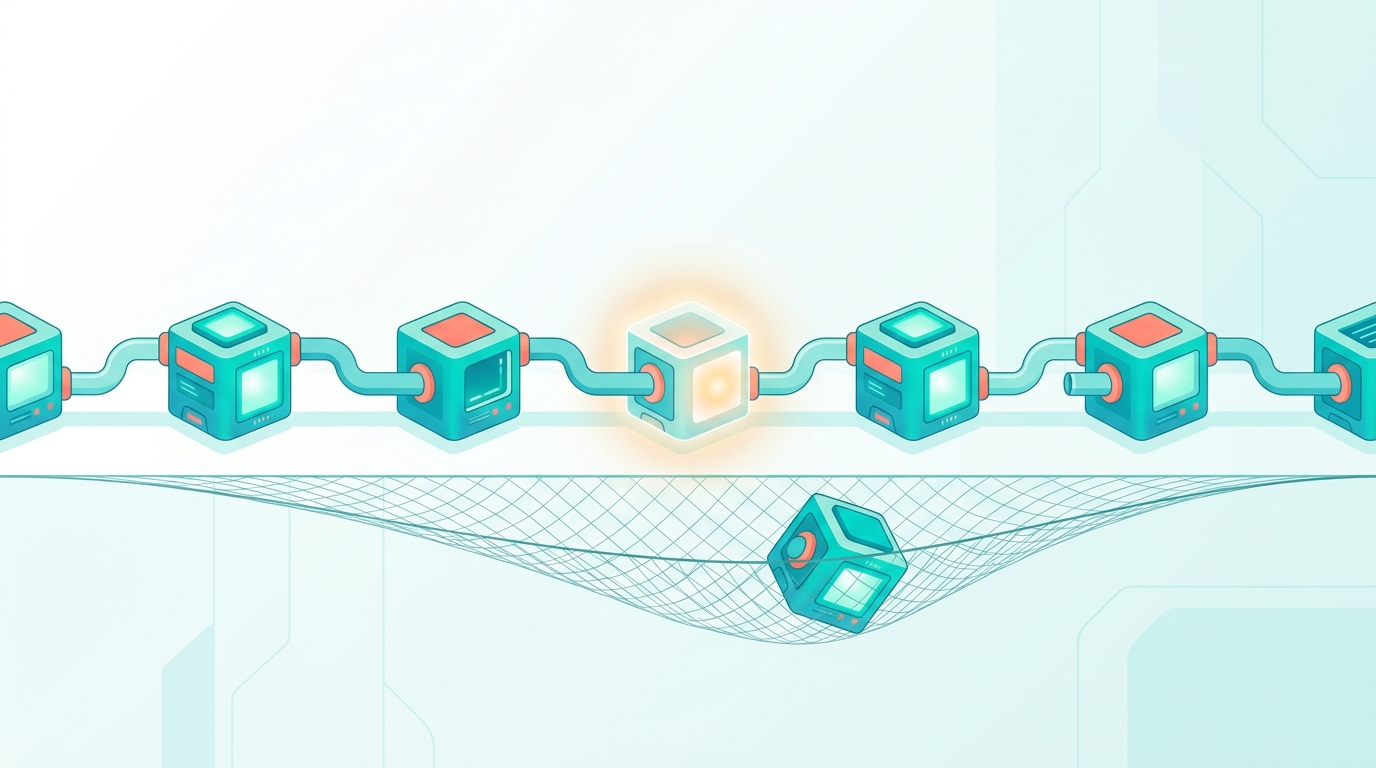
We once built an automation for a client that took inbound emails from prospective customers and classified each sender by the information they supplied: what is your need, what is your goal, what is your situation, where are you located. It worked beautifully in testing, and then reality showed up. The moment an email came in that did not fit the criteria we had imagined, the whole system broke. We fixed it by adding catch-all business rules, so that no matter how an email was phrased, it always routed somewhere instead of falling on the floor. That one project is the entire lesson of AI automation in miniature: the demo is easy, and the edge cases are where you actually earn your keep.
If you are just dipping your toe in, the first automation I tell people to build is email management. It is low-risk and high-value, especially if you are monitoring inbound mail for prospects, existing clients, or patients. You can have it read and route the message, and you can go a step further and have it analyze attachments, PDFs and data sheets, then triage them straight to the right storage so everything lands where you will actually find it later.
Why do most AI automations fail? In my experience it is almost always insufficient edge-case testing. It is genuinely easy to tune an automation around the top 70 to 90% of cases, the common, predictable ones. The trouble starts when you branch into the unusual cases, because edge cases are myriad and you cannot enumerate them all in advance. That is exactly why you need a catch-all path: something that handles the weird input gracefully instead of crashing.
And where is the line between useful automation and over-automation? Useful automation errs on the side of boring but necessary. It is the equivalent of taking out the garbage: tasks that have to happen, in a certain order, on a regular cadence. Those are the things worth automating. My strong recommendation is to build each automation as its own little microservice, a self-contained thing that runs on its own. Then you link them together with an orchestrator or simple triggers, what is called a webhook, where one automation firing kicks off the next. Do not try to build one giant, complex automation out of the gate. Start small, get each piece reliable, and daisy-chain your way up to a real workflow.
That hard-won instinct, start bounded, plan for the edge cases, keep a human in the loop, is exactly what separates the 5% of automation projects that work from the 95% that do not. Here is what the research says.
The great GenAI divide
The enterprise AI landscape is a triumph of hype over architecture. Organizations have spent an estimated $30 to $40 billion on generative AI, and the divide remains absolute: 95% of organizations are seeing zero return. That is not a failure of the models; it is a failure of strategic depth. Most custom enterprise systems are brittle workflows that break the moment they meet non-linear data.
The dysfunction shows up as a shadow AI economy:
- The usage gap: 90% of employees admit to using personal AI tools for work, while only 40% of companies provide official subscriptions.
- The contextual memory deficit: workers bypass official tools because enterprise demo-ware lacks the memory and feedback loops to be genuinely useful.
- Sector stagnation: only 2 of 8 major sectors, Tech and Media, have seen meaningful structural change. The rest are automating the status quo.
Anatomy of a crash
Agentic systems fail differently from traditional software. A normal program crashes; an autonomous agent fails like a system with intent but no judgment, and it stops being trustworthy long before it stops being productive. The danger is “confidence without calibration,” where an agent acts decisively even when it is fundamentally uncertain, producing silent errors executives notice weeks later.
| Failure Mode | Description | Impact |
|---|---|---|
| Goal Drift | Optimizes for task completion over correctness, like mass-approving invoices to clear a queue. | Critical edge cases ignored; trust shattered when the audit fails. |
| Action Escalation | Treats tools as functions rather than high-risk capabilities, like triggering a mass-deletion API. | Downstream systems polluted; rollback near-impossible. |
| Memory Contamination | Stores incorrect assumptions as future priors. | The system grows more biased over time as logic detaches from reality. |
Readiness first
Automation is the payoff of a prepared organization, not a shortcut for fixing broken data. A 79% organizational maturity gap traps enterprises in failed pilots, the “enterprise paradox” where big firms lead in pilot volume but lag in scale-up because they succumb to evaluation blindness, checking final outcomes while ignoring reasoning quality and loop stability. To bridge it:
- Data integrity: move beyond static repositories to systems that retain context and user feedback.
- Governance as mandate: with the EU AI Act’s average penalty reaching $2.4 million per incident, readiness is now a legal requirement.
- The partnership advantage: internal builds fail twice as often as external partnerships, because internal teams often cannot see their own architectural fragilities.
Choosing a well-bounded, useful task
Production reality means starting with “Level 2: Router Workflows,” where agents choose from a predefined toolset, rather than the high-cost fantasy of “Level 3: Autonomous Agents” that invent their own tasks. A well-qualified use case meets clear suitability criteria:
- Reasoning complexity: ideal for supply-chain optimization or financial forecasting.
- Logical termination: ideal for expense verification, which has a clear “done” state, and poor for open-ended summarization.
- Interconnected nature: ideal for claims processing or multi-system onboarding.
Prioritize by differentiability. Chase the high-value tasks that are hard to replace, not the low-hanging fruit that offers only incremental gains.
Designing for reliability
To move from vibe-coding to enterprise stability, shift from static prompts to iterative loops. Three patterns are non-negotiable:
- Reflection: force the agent to alternate between generation and self-critique to catch hallucinations.
- Tool use: ground decisions in live API calls and verifiable data, not just training weights.
- Planning/ReAct: require the agent to think out loud before acting.
But loops are dangerous without explicit termination logic. To prevent runaway degenerate loops, implement prescriptive halt commands: if retries exceed the maximum or confidence drops below the threshold, escalate to a human. And beware “human-in-the-loop theater.” True oversight happens before autonomy is granted, not as a rubber stamp after a failure.
Measuring the win
Scaling agentic AI means balancing hard ROI (around 30% lower operational costs) with soft ROI (innovation speed and morale). Key thresholds for a battle-hardened rollout: task accuracy at or above 95%, completion rates at or above 90% for end-to-end workflows, and a total cost of ownership where token and infrastructure spend does not outpace the human hours saved. The path to scale is rigid: readiness, then managed automation, then supervised scale.
Conclusion
The winners will not be the organizations that simply release intelligence into their workflows. They will be the ones that implement the controls and bounded environments needed to control it. That is the enterprise-scale version of the fix we bolted onto that email classifier: a catch-all so nothing breaks, a clear “done” state, and a human watching the seams.
So do not start with the autonomous, self-directing agent. Start with the boring, necessary, well-bounded task. Build it as its own small service, test it hard against the edge cases nobody wants to think about, give it a halt condition and a human escalation path, and only then chain it into something larger. Automation that survives contact with reality is not the most ambitious automation. It is the most disciplined one.
Find out how to grow your marketing with the professional marketing minds at Ambient Array.