

Before your team builds another AI tool, it is worth asking whether you are doing marketing or building software.
Why projects fail before they start
The statistic is arresting: a widely circulated MIT NANDA report concluded that 95 percent of organizations in its sample were getting no measurable return from enterprise generative AI initiatives. The exact percentage should be read in the context of that report, not as a universal law. Still, the business lesson is hard to ignore. Companies are spending heavily on AI while many projects fail to cross the gap between an impressive demo and a workflow that produces financial value.
Marketing teams often contribute to the problem by starting with the technology. Someone sees a new model, imagines a comprehensive internal platform, and starts building. Weeks later, the team owns fragile software, undocumented prompts, recurring maintenance, and a workflow only one person understands. The project has created a new operational responsibility before proving it solves an important problem.
Separate a commodity problem from your problem
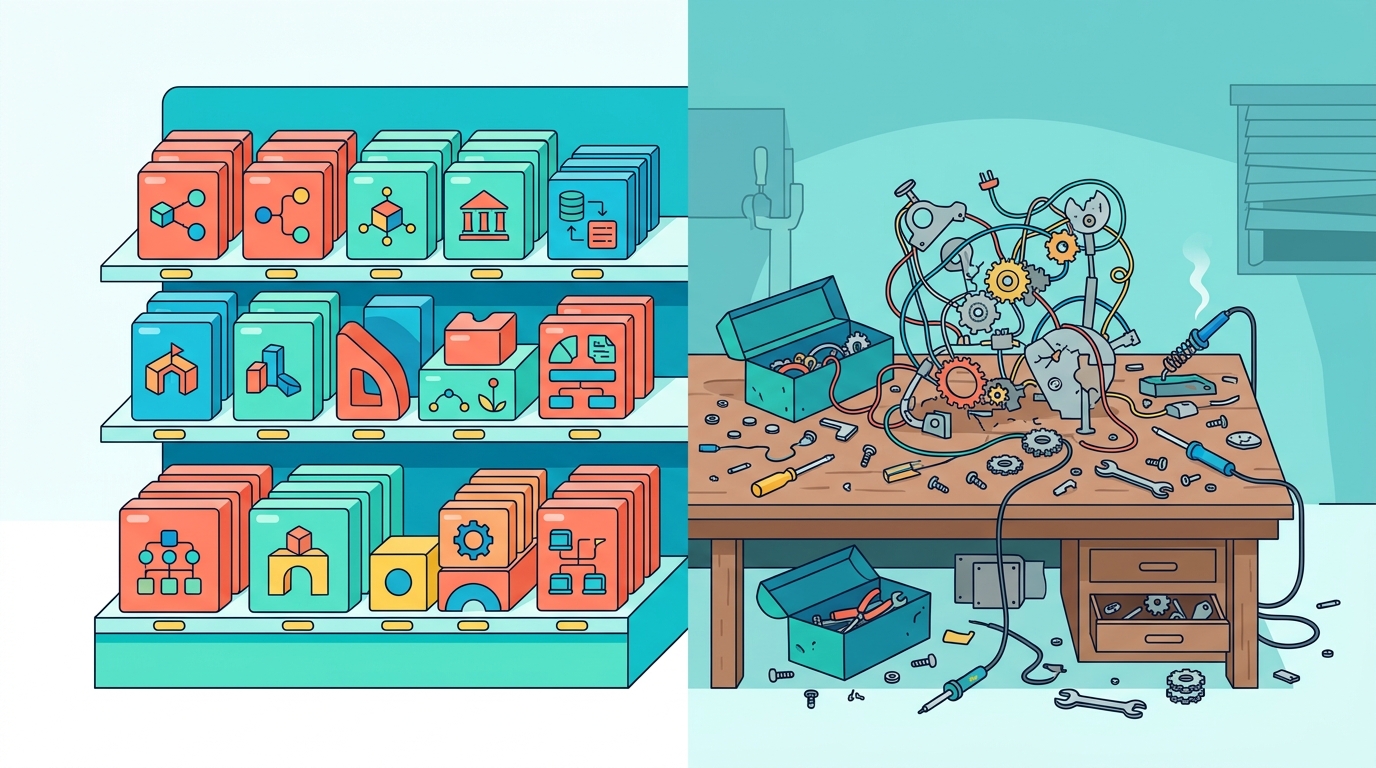
Growth Memo authors Kevin Indig and Amanda Johnson offer a useful dividing line. Rank tracking, citation monitoring, brand-mention tracking, crawl diagnostics, and content scoring are common problems. Vendors solve them across thousands of customers, maintain the integrations, absorb product changes, and provide support when something breaks. Building an internal substitute rarely creates strategic differentiation. It creates another software product your marketing department has to maintain.
Your problem is different. It includes your approval process, customer data, brand standards, reporting cadence, subject-matter expertise, and the judgments that separate acceptable work from excellent work. Those workflows may deserve customization. But custom does not have to mean built entirely in-house. A fractional expert or specialist brings patterns learned across prior implementations, which keeps your team from discovering every failure mode on company time.
When buying beats building
Buy proven software when the need is common, the outputs are standardized, and the vendor’s scale creates an advantage. Compare the subscription price with the full internal cost: planning, meetings, development, testing, documentation, retraining, monitoring, repairs, and adaptation when a model or external system changes. Maintenance is not an edge case. It is part of the product.
Bring in outside expertise when the workflow is particular to your company but the implementation challenge is familiar. That might mean connecting proprietary data to a reporting process, designing human review, or adapting an established tool to your approval structure. Build internally only when the workflow is strategically distinctive, your team understands it well enough to verify the results, and owning the capability will create a durable advantage.
A useful test is whether customers would value the capability itself or only the result it produces. Few customers care that a marketing team built its own rank tracker. They care whether the team spots an important decline and responds intelligently. Internal engineering earns its cost when ownership improves speed, insight, control, or differentiation in a way an established product cannot.
There is another useful limit: automate a step before you automate a job. A good candidate has a defined input, a defined output, and a quick human check. Turning raw data into a standardized table may qualify. Replacing a strategist’s entire sequence of synthesis, negotiation, and decision-making probably does not.
A 30-minute audit for this quarter
Diagnose before you spend. List every AI tool, pilot, and proposed build on one page. For each item, write down the business outcome, the owner, the recurring maintenance cost, and the person capable of checking the result by hand. Then put each one in one of four categories:
- Buy: a vendor already solves the problem reliably.
- Borrow expertise: the workflow is yours, but an experienced implementer can configure it faster.
- Build: the capability is strategically unique and worth owning.
- Stop: there is no clear outcome, owner, verification method, or deadline for proving value.
For anything left in the build category, pick one narrowly defined step, establish a baseline, and set a kill date. Decide in advance what improvement would justify continued investment. This is where Ambient Array can help: not by forcing every marketing problem into a new tool, but by sorting what should be bought, what deserves customization, and where human judgment is still the real source of value.
The goal is not the most sophisticated AI marketing stack. It is the smallest dependable system that makes your marketing organization measurably better.
Find out how to grow your marketing with the professional marketing minds at Ambient Array.